If you spend any time around a security team, you start to notice something pretty quickly: there is always something happening. Logs are streaming in, alerts are firing, some of the logs look strange, reports of users having clicked on things they shouldn’t have, and systems are behaving or reporting in ways that can fully be explained. That constant motion is not a sign that something is wrong, it’s just the normal state of cybersecurity work. Most of it gets reviewed and handled quietly, inside the team, without anyone else needing to know.
That’s what makes the real question harder than it first appears. It’s not “did something happen?” because something always is. The better question is whether what happened actually matters beyond the security team. In other words, when does this stop being routine work and start becoming identified as being an incident?
An incident isn’t defined just by how technical or unusual something is. It’s defined by consequence. Most security activity stays contained where the analysts investigate alerts, clean up endpoints, block suspicious traffic, and move on. That’s expected, and it’s healthy. If every one of those actions triggered an incident response, the organization would spend most of its time reacting and none of its time operating.
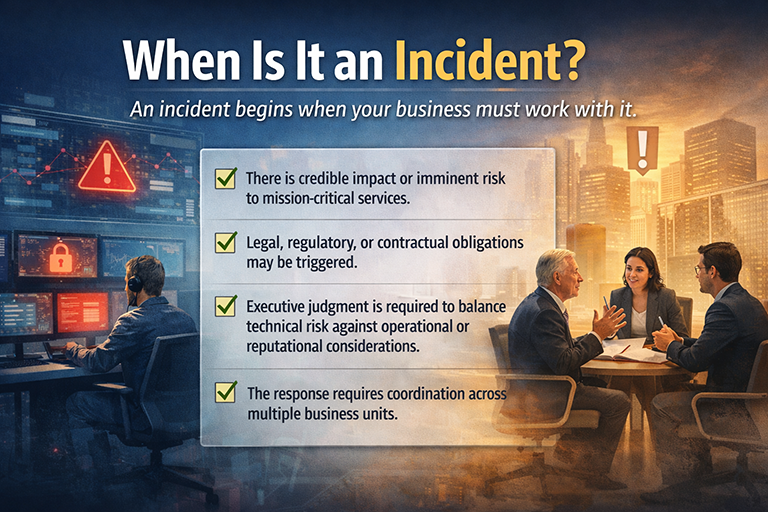
The shift happens when the situation starts to carry weight the rest of the organization can’t ignore. That might mean a real impact to a critical system, or a credible risk that sensitive data has been exposed. It might mean legal or regulatory obligations come into play, or simply that the response requires decisions that go beyond the security team. These tradeoffs typically involve operations, reputation, or risk tolerance. At that point the issue is no longer just technical, the business has a stake in what happens next.
Where organizations tend to struggle is not in detection, but in judgment. Some escalate too quickly, turning routine activity into a steady stream of “incidents” that exhaust attention and dilute urgency. Others wait too long, keeping something contained within cybersecurity even as the implications grow. Both of these approaches create problems, just in different ways.
The organizations that handle this well usually have one thing in common: they’ve done the thinking ahead of time. They’ve defined what matters, where the thresholds are, and who needs to be involved when those thresholds are crossed. Just as importantly, they’ve built trust in that process so escalation is seen as a normal part of operating and not just another overreaction.
Cybersecurity work never really stops. There will always be alerts, investigations, and unresolved questions within the process. An incident begins when those things can’t stay contained anymore and the business itself has to step in to understand the risk and decide what happens next. That distinction matters because incidents change who owns the problem. Cybersecurity may lead the technical response, but the organization owns the risk.